


2026 February 27

Ramen Style
“Mazemen,” which literally means “mixed noodles,” is a noodle dish designed to be mixed before eating. Its defining characteristic is the intentional absence of soup, setting it apart from dishes such as ramen or soba. Flavor comes together when the diner mixes the savory sauce, aromatic oil, noodles, and toppings directly in the bowl. Without broth to dilute the experience, the texture of the noodles and the richness of the sauce and oil are delivered straight to the palate. This article explores its key components, historical background, and preparation methods.
1. Main Features
Mazemen offers a brothless noodle experience that differs fundamentally from conventional ramen or tsukemen. Its appeal can be understood through the following three defining features.
Mixing Before Eating
The defining feature of mazemen is that the diner is responsible for completing the dish. Noodles, sauce, aromatic oil, and toppings are served together in the bowl in an intentionally unfinished state. The dish comes together only when the diner mixes everything thoroughly, allowing the sauce and oil to coat the noodles evenly. This final act creates a sense of participation while also allowing the flavor to evolve from the first bite to the last.
Complexity of Flavor
Mazemen is built not on a simple pairing of sauce and oil, but on the layered interaction of diverse ingredients. Additions such as minced chashu, green onions, egg yolk, fish powder, seaweed, and spices introduce contrasting textures and aromas. As these elements interact, each bite delivers a slightly different balance, producing a rich, multi-layered flavor experience.
Adjustment via Condiments
Another defining aspect of mazemen is its flexibility at the table. Vinegar can be added mid-way to lighten the richness of the oils, while chili oil introduces heat and fragrance. Garlic or pepper further shifts the profile toward a bolder finish. This ability to customize the flavor allows mazemen to remain engaging until the very last bite.
2. Components
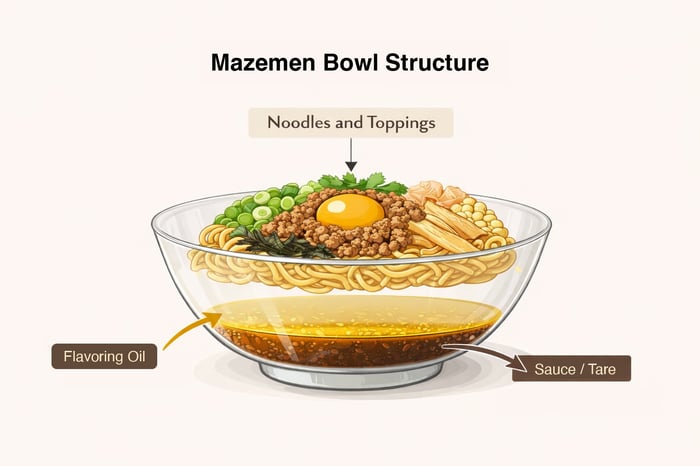
Mazemen is constructed from four pillars: sauce, aromatic oil, toppings, and noodles. The sauce sets the direction, the oil enhances aroma and richness, the toppings provide diversity, and the noodles accept and unify them all. While each element plays an independent role, their mutual interaction elevates the overall perfection of the dish.
Sauce (Tare)
The sauce in mazemen is not merely "seasoning"; it is the central element that determines the fundamental tone of the entire dish. While bases like soy sauce, miso, and salt are standard, depth and complexity are created by adding extraction components such as kelp (kombu), bonito flakes, and dried sardines, along with spices. In recent years, infinite variations have become possible, including seafood-based sauces, spicy varieties, and even Western-style cheese sauces.
Flavoring Oil (Komi-Abura)
Aromatic oil - fat infused with the scent and flavor of ingredients - is the element that governs the aroma and richness (koku) of mazemen. The richness of chicken oil (chiyu), the seafood profile of dried sardine oil, or the heat and stimulation of chili oil each give the dish a different expression. Furthermore, the oil functions as a "lubricant" that coats the noodle surface, allowing the sauce to cling evenly and making mixing easier. In other words, aromatic oil serves a dual role: reinforcing flavor and facilitating the practical process of eating.
Toppings (Guzai)
Toppings bring both gustatory and visual diversity to mazemen. Typical examples include cooked pork or chicken, aromatic vegetables (chives, green onions, onions), egg yolks, fish powder, and shredded nori. Recently, additions like cheese, fried batter bits (agedama), and spices have become more common. The flexibility where "the direction of the dish changes dramatically depending on the toppings" is one of the charms of mazemen.
Noodles (Men)
Acting as a canvas that accepts and unifies the sauce, oil, and toppings, the noodles are the main subject of mazemen. Medium-thick to extra-thick curly noodles are generally used, with emphasis placed on a chewy texture and the ability to catch the sauce. Recently, the use of new materials such as whole wheat noodles, gluten-free noodles, and high-protein noodles has progressed, aiming to adapt to health-conscious trends and overseas markets.
3. Historical Background
The Beginning: Born from a “Failure”
Modern mazemen as we know it began in 2008 with the creation of “Taiwan Mazesoba” at Menya Hanabi in Nagoya. Interestingly, the dish was born from an unexpected failure. At the time, the shop was developing a spicy minced pork topping for Taiwan Ramen. During testing, however, the meat failed to blend well with the soup and did not meet the shop’s standards as a complete dish. Rather than discarding the ingredients, the owner tried serving the seasoned minced pork directly over noodles, without any broth. The result was surprisingly well received. What began as an improvised solution soon became a new menu item known as “Taiwan Mazesoba,” marking the birth of a completely new style of noodle dish—one where flavors are mixed together rather than dissolved in soup.
Expansion and Diversification
Gaining attention as an “invention born of failure,” Taiwan Mazesoba quickly spread across Japan. As the dish traveled, it absorbed regional tastes and local food cultures. In Hiroshima, a spicy version known as soupless tantanmen emerged, highlighting the numbing kick of Sichuan pepper. In Tokyo, more experimental styles appeared, incorporating Japanese dashi or even Western-inspired elements such as cheese. Mazemen gradually evolved from a single idea into a flexible, creative category.
The Birth of “Oimeshi”
Another innovation came from Menya Hanabi itself: oimeshi, or follow-up rice. After finishing the noodles, diners add a small portion of white rice to the remaining sauce and toppings, allowing the rich umami flavors to be enjoyed to the very end. This practice reduced waste while extending the pleasure of the dish, and it has since become a standard part of the mazemen experience.
The Wave of Globalization
Since the 2010s, mazemen has spread beyond Japan and gained popularity overseas. In cities such as New York and Los Angeles, it has been adapted to local tastes and dietary preferences, resulting in variations that include gluten-free noodles and vegetarian options. What began as a small experiment born from failure has grown into a dish enjoyed by people around the world.
4. Global Expansion of Mazemen
Mazemen Goes Global Mazemen has gradually spread beyond Japan and gained popularity around the world, evolving in different ways depending on local food cultures and preferences.
Mazemen in Asia
Mazemen gained traction relatively early in parts of Asia, particularly in Taiwan, Hong Kong, and Singapore. In Taiwan, the dish blended naturally with existing noodle traditions, leading to localized versions that incorporate regional ingredients and flavors. In Hong Kong and Singapore, ramen specialty shops introduced mazemen during the broader boom in Japanese cuisine. There, it is often recognized simply as “soupless ramen,” making it easy for diners to understand and enjoy.
Mazemen in North America
In major U.S. cities such as New York, Los Angeles, and San Francisco, mazemen is typically served under its original name. Its lack of broth makes it especially appealing to health-conscious diners and those following vegetarian or flexible diets. As a result, mazemen has found a place as a highly customizable noodle dish that can accommodate a wide range of dietary preferences.
Mazemen in Europe
In cities like London, Paris, and Berlin, mazemen—often introduced as “mazesoba”—has appeared alongside the growing ramen scene. Europe’s familiarity with pasta dishes, where noodles are coated with sauce and ingredients rather than served in soup, makes this style of eating feel intuitive. To distinguish it clearly from traditional broth-based ramen, the dish is frequently marketed as “soupless,” helping diners understand its appeal at a glance.
Local Adaptation Trends
As mazemen spreads globally, several adaptation trends have emerged. Local ingredients such as cheese, herbs, and even tomato-based sauces are sometimes incorporated, reflecting Western tastes. At the same time, health-focused variations, including gluten-free noodles, low-carb options, and vegan versions, have become increasingly common. While distinctions between “mazemen” and “Taiwan Mazesoba” are often emphasized in Japan, overseas they are generally introduced under a single name. This has helped create a more unified and easily recognizable identity for the dish worldwide.
5. Diversity of Styles: Global Variations
Mazemen has evolved far beyond its accidental origins. Today, we categorize it into four distinct styles based on toppings and sauce viscosity.
| Category | Sauce Base | Examples of Aromatic Oil | Examples of Toppings | Noodle Characteristics | Description |
| Standard Style | Soy sauce & seafood | Chicken fat oil, dried sardine oil | Pork, soft-boiled egg, bamboo shoots | Medium-thick curly noodles, emphasis on balance | A well-balanced flavor profile built on soy sauce and seafood-based dashi. |
| Rich / Heavy Style | Tonkotsu & back fat | Lard, garlic oil | Chopped garlic, cheese | Extra-thick straight noodles with strong bite | Characterized by high concentration and fat content, using pork bone soup and/or pork back fat. |
| Spice-Forward Style | Taiwanese-style | Chili oil, Sichuan pepper oil | Garlic chives, spicy miso, chili peppers | Medium-thick to thick noodles that firmly hold spice | The flavor is driven primarily by chili heat (la) and the numbing sensation of Sichuan pepper (ma). |
| Japanese Dashi Style | Salt / white soy sauce | Bonito oil, mackerel flake oil | Grated daikon, bonito flakes, yuzu pepper | Medium-thin noodles that highlight delicate dashi flavors | Emphasizes dashi flavors extracted from dried seafood and kelp. |
| Creative / Fusion Style | Variable | Truffle oil, curry oil | Prosciutto, cilantro, tomatoes | Flexible (e.g., flat noodles) | A style that incorporates techniques and ingredients from other cuisines. |
| Plant-Based Style | Vegetables & soy milk | Olive oil, flaxseed oil | Steamed vegetables, avocado, mushrooms | Health-oriented options such as whole-wheat or gluten-free noodles | Composed primarily of vegetables and legumes, excluding animal-based ingredients. |
6. How to Enjoy Mazemen
Mazemen is unique in that it is not truly “complete” when it arrives at the table. Instead, the act of eating - mixing, adjusting, and finishing - is considered the final stage of the dish itself. To fully enjoy mazemen, the experience is best approached in three simple steps.
The Mix
Mixing: Completing the Dish When the bowl is first served, the sauce and aromatic oil rest at the bottom, while the noodles and toppings sit on top. At this point, the dish is still intentionally unfinished.
- Using chopsticks and a spoon (renge), mix the entire bowl thoroughly until everything is evenly combined.
- The more carefully you mix, the more evenly the sauce coats each noodle, and the toppings distribute throughout the bowl.
- This step is more than just preparation—it is the moment when you actively take part in completing the dish.
Flavor Change (Ajihen)
Enjoying Customization About halfway through the bowl, many diners begin adjusting the flavor using tabletop condiments. This practice, known as ajihen, allows the taste to evolve as you eat.
- Adding vinegar introduces a refreshing acidity that cuts through the richness of the oil.
- Chili oil (rayu) brings heat and aroma, while sansho or black pepper can add a sharper spice.
- Some diners even add a small amount of mayonnaise for extra creaminess. By making small adjustments along the way, you can enjoy several flavor profiles in a single bowl.
Oimeshi
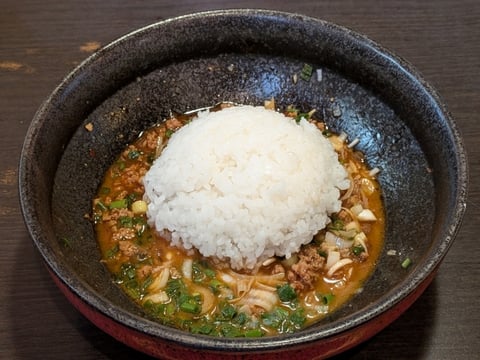
The Grand Finale After finishing the noodles, a concentrated mixture of sauce and toppings rich in umami remains at the bottom of the bowl. Adding a small portion of white rice to this mixture is known as oimeshi.
- The rice provides a new texture and allows you to savor the remaining flavors without waste.
- This practice was popularized by Menya Hanabi and has since become a standard feature at mazemen shops across Japan.
- Oimeshi represents the spirit of mazemen—enjoying the dish fully, right down to the very last grain.
7. Enjoying Mazemen at Home
While professional mazemen serves as a canvas for chefs to showcase their craftsmanship, the dish is surprisingly accessible for home cooks because it requires no complex soup preparation. By mastering a few key points about the sauce, anyone can create a delicious bowl at home. For detailed recipes, please check out our English guide here.
Cooking Tips for Success:
-
Warm the Sauce (Recommended): Warming the sauce is recommended when you have time. Gently heating the sauce helped the flavors blend more smoothly and cohesively. It also allows the aromas of garlic and sesame oil to bloom, creating a more balanced and rounded taste.
How-to (Microwave): Combine all sauce ingredients in a bowl, cover loosely with plastic wrap, and microwave for 20–30 seconds. Stir well to combine.
Stovetop Alternative: Combine all sauce ingredients in a small saucepan and warm over low heat for a few minutes, stirring gently, just until warmed through and aromatic. Do not bring to a boil. Remove from heat and stir before using.
You can skip this step and simply mix the sauce as-is — it will still be delicious — but warming it creates a smoother overall finish.
- Warm the Bowl: Pre-warming your serving bowl enhances both aroma and texture. A warm bowl helps the fragrance of the sesame oil bloom and ensures the sauce coats the noodles evenly without clumping.
- Customize the Aromatics: Adjust the amount of garlic and ginger to suit your preference. If you prefer more heat, increase the chili powder; for a milder flavor, simply reduce it.
- Add Depth with Fermented Toppings: Don’t be afraid to experiment. Adding fermented ingredients like natto or cheese introduces complex layers of umami and richness, transforming a simple bowl into something truly special.
WHY Mazemen DESERVES TO BE MORE THAN “SOUPLESS RAMEN”
Mazemen is more than just a soupless noodle dish - it is an interactive culinary experience.
Born from a happy accident, this single bowl has evolved to symbolize the freedom and limitless potential of modern noodle cuisine. It is a harmony of four core elements - sauce, aromatic oil, toppings, and noodles. The ritual of mixing by hand, the customization with condiments, and the final satisfaction of oimeshi all combine to create a deeply engaging, multi-layered experience. Unbound by the constraints of soup, mazemen offers chefs a canvas for creativity, while giving diners the joy of crafting a flavor profile that is uniquely their own.
Whether you enjoy it at a specialty shop or create it in your own kitchen, we invite you to explore the depth of this dish and discover your own perfect bowl of mazemen.